Websites
Why website speed matters for small business websites

Zeeshan Sangi
· 6 min read
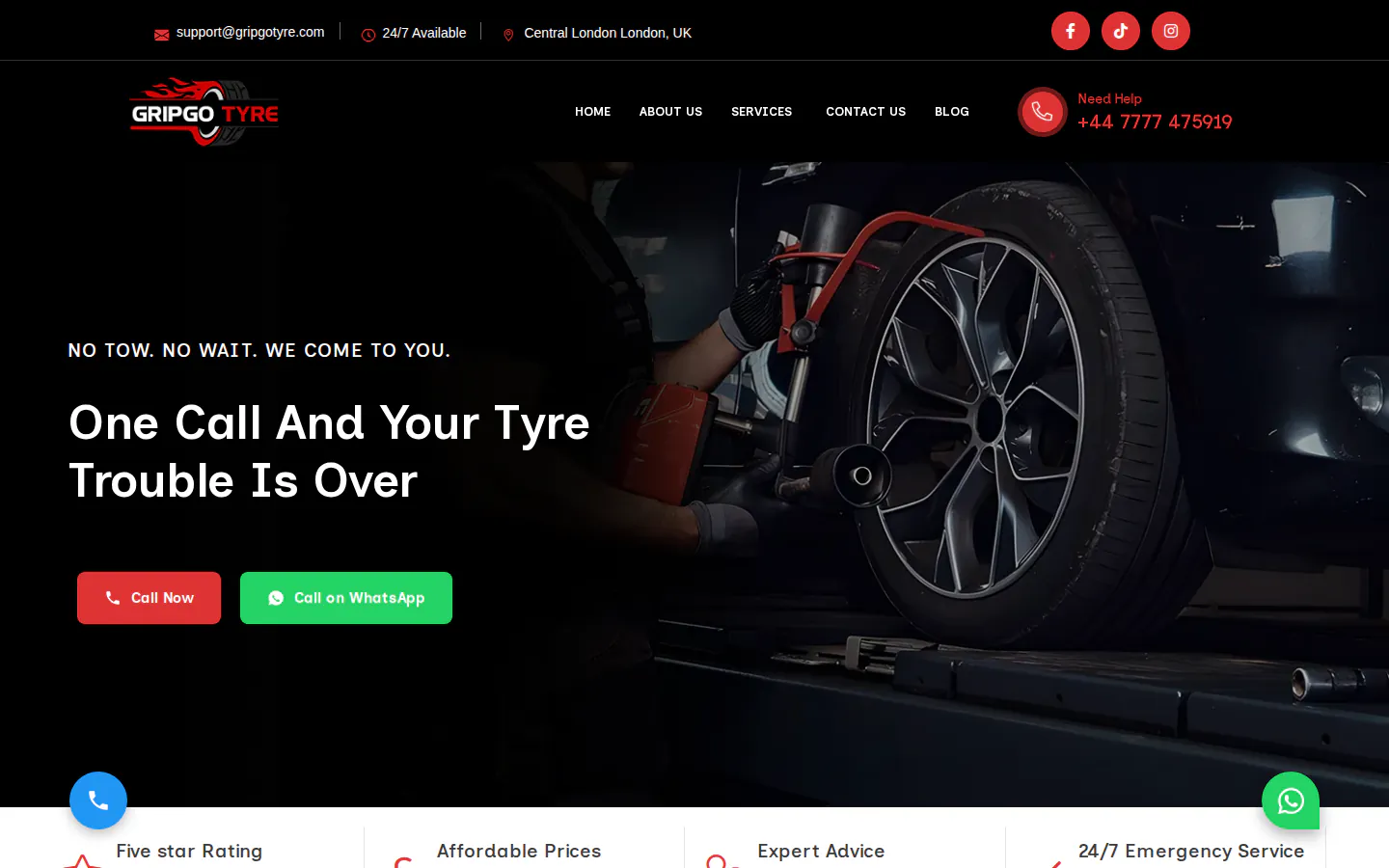
Picture someone standing next to their car on the side of the road with a flat tyre. They search for mobile tyre fitting near them, tap the first result, and wait. If your page is still a white screen after three seconds, they go back and tap the next one. You never knew they were there.
That is the real cost of a slow website. It does not show up as a complaint or a bad review. It shows up as people who almost became customers and then quietly left. In this article I will explain why speed matters so much for a small business, how to check your own site in a couple of minutes, and what actually makes a website fast.
People leave slow websites, and they leave fast
Google has studied this for years. In research published in 2018 (with SOASTA, using 2017 data), Google found that as the time a page takes to load goes from one second to three seconds, the chance that a visitor leaves without doing anything rises by 32 percent. Push that to five seconds and the chance rises by 90 percent. An earlier 2016 Google study reported that 53 percent of mobile visits were abandoned when a page took longer than three seconds to load. Phones and networks are faster now, but people have become less patient, not more.
For a large online shop that is a revenue problem. For a small business it can be worse, because you usually get fewer visitors in the first place. If only forty people a week find your website, losing half of them to a loading screen is a big share of your potential work.
Most of these visitors are on phones, often on mobile data rather than fast home internet. A site that feels fine on your office computer can feel very slow to someone on a train or in a car park.
Speed also affects how Google ranks you
Google wants to send people to pages that give them a good experience, and loading speed is part of that. It measures this with a set of signals called Core Web Vitals. The one most people should watch first is Largest Contentful Paint, or LCP, which is how long it takes for the main content of the page to appear. Google recommends an LCP of 2.5 seconds or less.
Speed will not lift a weak page to the top of the results on its own. Good content that answers what people are searching for still matters most. But when two local businesses offer similar pages, the one that loads quickly and works well on a phone has an advantage, and that small edge adds up over months.
How to test your website in two minutes
You do not need to be technical to get a clear picture. Google offers a free tool called PageSpeed Insights. Paste in your website address and it tests the page the way a phone would load it.
Look at the mobile results first, because that is where most of your visitors are. The tool gives you a performance score and shows your Core Web Vitals. If your LCP is above 2.5 seconds, or the score is in the orange or red range, your site is likely losing visitors.
Test your homepage and also the page people use most, such as your contact page or your main service page. Sometimes the homepage is fine and a single heavy page is the real problem.
What usually makes small business websites slow
When I look at slow sites for clients, the same few causes come up again and again. The good news is that most of them are fixable.
- +Huge images. A photo straight from a phone or a stock site can be several megabytes. On a website it rarely needs to be more than a few hundred kilobytes.
- +Too many plugins or add-ons. Each one can add extra code that every visitor has to download, even on pages that do not use it.
- +Heavy page builders and themes. Some ready-made themes load fonts, sliders and animations on every page whether you use them or not.
- +Cheap or overloaded hosting. If the server is slow to respond, everything else waits.
- +Too many third-party scripts. Chat widgets, tracking pixels and embedded social feeds each add their own delay.
How I build websites that load quickly
I build sites with React and Next.js, and speed is part of the plan from the first day rather than something patched on at the end. Pages are prepared in advance where possible, so the server can send a finished page instead of building it while your visitor waits.
Images are resized and served in modern formats, and they only load when they are about to come into view. Fonts are loaded in a way that stops text from jumping around. I avoid adding scripts that a page does not need, and I test every site on a real phone before it goes live, not just on a fast laptop.
For a business like a tyre fitter or a chauffeur service, where people often search in a hurry, I make sure the phone number and the main call to action appear almost instantly, even before the rest of the page has finished loading.
Quick wins if you already have a website
If you are not ready for a new website, there are a few things you can do this week that often make a noticeable difference.
- +Compress your images with a free tool before uploading them, and replace the largest ones first.
- +Remove plugins, widgets and pop-ups you are not using.
- +Check that your hosting plan suits your traffic, and ask your host whether caching is turned on.
- +Remove old tracking codes for tools you no longer use.
- +Run PageSpeed Insights again after each change so you can see what helped.
Build for the phone first
When most of your visitors arrive on a phone, the phone version of your website is your real website. It is worth asking whoever builds your site to start with the small screen and work up, rather than squeezing a desktop design into a narrow column at the end.
In practice that means the most important information sits at the top: what you do, where you work and how to contact you. Buttons are large enough to tap with a thumb. Text is readable without zooming. Pop ups do not cover the page the moment it opens. Each of these makes the page feel faster, because visitors find what they need without scrolling, pinching or waiting.
It also means checking the site on an average phone, not only the newest model. Many of your customers will be using a phone that is a few years old, on a connection that is slower than you expect. If the site feels quick for them, it will feel quick for everyone.
Speed is part of the first impression
We often talk about first impressions in terms of design: the colours, the photos, the logo. But the very first thing a visitor experiences is how long they wait. A fast site feels professional and trustworthy before anyone has read a word. A slow one feels neglected, even if the business behind it is excellent.
If your website takes more than a few seconds to load on a phone, it is worth fixing. It is one of the few improvements that helps your visitors, your search rankings and your enquiries all at once. If you would like me to take a look at your current site and tell you honestly what is slowing it down, get in touch. I am happy to point you in the right direction even if you decide to fix it yourself.
Sources